What Is a VPN Protocol?
A VPN protocol is the set of rules that determines how your device communicates with a VPN server — how data is encrypted, how connections are established, and how the tunnel is maintained. The protocol choice affects speed, battery life, compatibility with restrictive firewalls, and security level.
Most VPN apps let you choose between protocols in the settings menu. The default is usually the fastest and most modern option, but understanding the differences helps you make the right choice for your situation.
Protocol Comparison Table
| Protocol | Speed | Security | Firewall Bypass | Best For |
|---|---|---|---|---|
| WireGuard | Fastest | Modern, excellent | Sometimes blocked | Speed, everyday use |
| NordLynx | Fastest | WireGuard + Double NAT | Sometimes blocked | NordVPN users |
| Lightway 2.0 | Very fast | wolfSSL, obfuscated | Best for China/UAE | ExpressVPN, censored countries |
| OpenVPN UDP | Medium | Battle-tested, excellent | Port 1194 often blocked | Maximum compatibility |
| OpenVPN TCP | Slow | Battle-tested | Port 443, hard to block | Restrictive firewalls |
| IKEv2/IPSec | Fast | Good | UDP 500, sometimes blocked | Mobile devices, reconnects well |
| L2TP/IPSec | Slow | Potentially compromised | Often blocked | Legacy only — avoid |
| PPTP | Fast | Broken — do not use | Sometimes works | Nothing — avoid entirely |
WireGuard: The Modern Standard
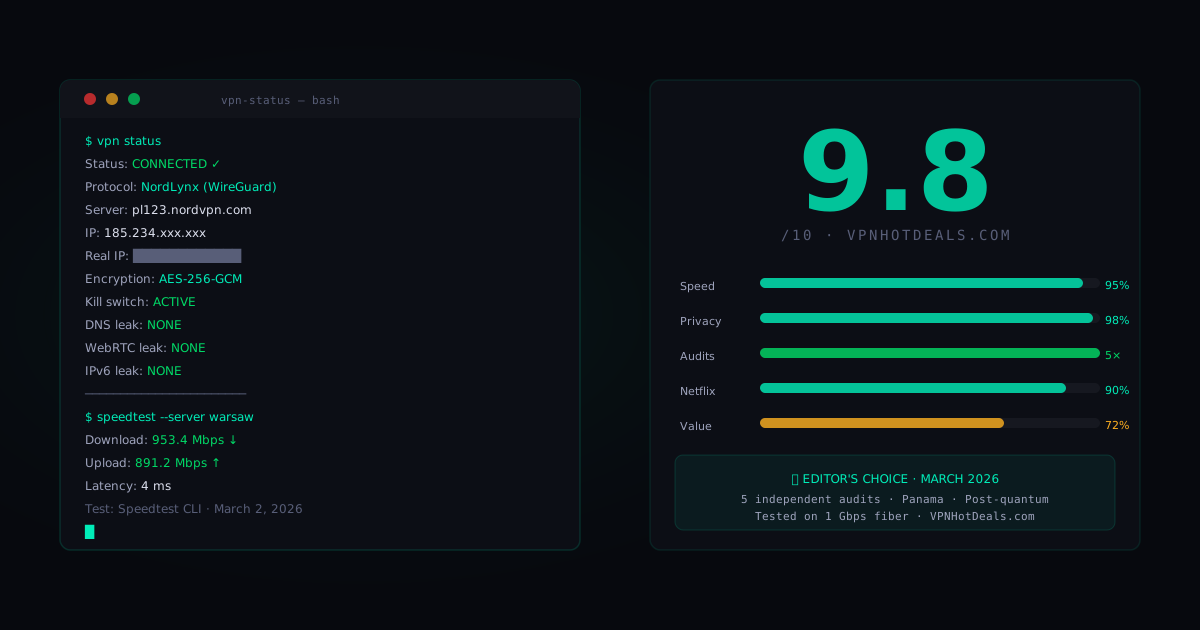
WireGuard was released in 2019 and has rapidly become the default choice for VPN speed. It uses only 4,000 lines of code (compared to OpenVPN's 400,000+), making it easier to audit for security vulnerabilities and faster to execute. In VPNHotDeals.com testing on a 1 Gbps line, NordVPN using NordLynx (WireGuard with a Double NAT privacy layer) reached 953 Mbps — essentially saturating the connection. The same server on OpenVPN UDP reached 480 Mbps.
WireGuard's limitation: it assigns a fixed IP address to each user by default, which is a privacy concern. NordVPN addresses this with their Double NAT implementation (NordLynx). Mullvad uses WireGuard directly but assigns dynamic IPs on their infrastructure. ProtonVPN uses WireGuard with their own privacy layer.
OpenVPN: The Battle-Tested Standard
OpenVPN has been the industry standard since 2001. Its 400,000+ lines of code have been scrutinized by security researchers for over two decades — no major vulnerabilities have been discovered. It is slower than WireGuard but provides excellent compatibility: OpenVPN over TCP port 443 is nearly impossible to block because port 443 is the same port used by HTTPS web browsing. Blocking it would break most of the internet.
Use OpenVPN when: you are in a network that blocks WireGuard (corporate networks, some countries), you need maximum compatibility with older devices, or you are troubleshooting a connection that does not work on WireGuard. Most VPN apps offer OpenVPN as a fallback option.
Proprietary Protocols: Lightway, NordLynx, Chameleon
Several VPN providers have developed proprietary protocols built on WireGuard or other open standards but with additional features. ExpressVPN's Lightway 2.0 adds obfuscation to WireGuard traffic, making it look like HTTPS — the only major protocol that reliably bypasses China's Great Firewall. NordVPN's NordLynx adds a Double NAT layer to WireGuard to solve the static IP privacy issue. VyprVPN's Chameleon scrambles OpenVPN packets to bypass DPI.
For everyday use in uncensored countries: use NordLynx (NordVPN) or Lightway (ExpressVPN) for speed. For censored countries: use Lightway 2.0 (ExpressVPN) or NordVPN's obfuscated servers.
WireGuard-based protocols are the fastest: NordLynx (NordVPN) reached 953 Mbps in VPNHotDeals.com testing on a 1 Gbps line. Lightway 2.0 (ExpressVPN) reached 930 Mbps. OpenVPN UDP is about 50% slower than WireGuard on the same hardware. IKEv2 falls between them. L2TP and PPTP are slower and should not be used.
WireGuard (or WireGuard-based protocols like NordLynx) for everyday use — it is faster, uses less battery on mobile, and has excellent security. Use OpenVPN TCP port 443 if you are on a restrictive network that blocks WireGuard (corporate networks, some countries) because port 443 is nearly impossible to block. Most VPN apps handle this automatically — just set protocol to Automatic.
ExpressVPN uses Lightway 2.0 by default — their proprietary protocol built on wolfSSL with an obfuscation layer. It is one of the fastest protocols tested and the only mainstream VPN protocol that reliably bypasses China's Great Firewall. ExpressVPN also supports OpenVPN and IKEv2 as fallbacks.
No — avoid L2TP/IPSec. Documents leaked by Edward Snowden in 2013 suggested that the NSA may have compromised L2TP/IPSec. While this has never been definitively confirmed, the combination of possible compromise and slow speed makes it a poor choice. Use WireGuard or OpenVPN instead. PPTP is even worse — it was broken in the 1990s and should never be used for anything requiring actual security.